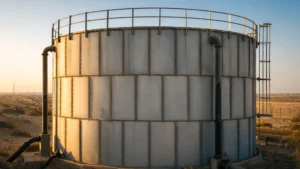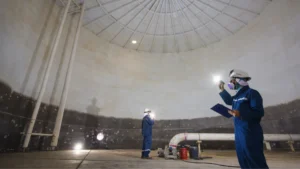
Epoxy linings have long been the standard generic resin type when specifiers are selecting products for lining new steel potable water tanks, or rehabilitating existing steel potable water storage tanks in North America. The one exception to this rule has been the Canadian potable water storage market. In Canada many specifiers have recognized the benefits offered by 100% Solids Elastomeric Polyurethane linings for 25+ years with admirable results. Many people will accept and understand the use of Elastomeric Polyurethanes for lining concrete storage tanks; I suggest that the same benefits that make these products attractive for concrete also make them a good choice when lining steel tanks.
The switch from traditional solvent based epoxy to 100% solids epoxy material has become the new standard in many areas of North America when lining Potable Water Storage Tanks. This change is mostly due to VOC (Volatile Organic Compounds) regulation changes, as well as potential taste and odor concerns. Many of the owners and engineers are also recognizing that increased dry film thickness = increased life cycle. There are still areas of the country where specifiers are reluctant to change from solvent based epoxy to 100% solids materials. What is the reason for the reluctance to embrace the new technology? It has much more to do with believing they will be limiting who is able to bid there projects, (not all painters have the equipment needed to apply the 100% Solids material), then it does with long term life cycle. I present the argument that limiting what painting contractors can bid the projects is not necessarily a bad idea. In 2018, if a tank painter has not invested in plural component spray equipment, I have to question the seriousness of their commitment to the water tank market if they are reluctant to invest. The move to 100% Solids materials is not going away, it is only going to spread as more and more jurisdictions are forced into low VOC products. The skill set required to operate a plural component spray pump is greater than that to operate a standard spray pump. This ensures that the contractor is more likely going to send their “A” Team to the project. To me that is a positive outcome for the owners.
Plural component spray equipment is required for most 100% Solids Epoxy material and for all 100% solids Elastomeric Polyurethanes. Plural Component equipment (for those who are not familiar) is specialized spray equipment used to apply ultra high solids materials. The Plural component system draws both the resin and curing agent separately down heated or heat traced lines to a mixing manifold. Once the material passes through the mix manifold, the material is further mixed through a series of strategically placed static mixers, the mixed material then flows to an integrated spray hose of 10-25’ (depending on the material), known commonly as a “whip line” and ultimately the spray gun. The plural component system allows for quick setting materials to be applied successfully at high film builds in a single coat application. Plural component spray also greatly reduces the amount of wasted material as the only the shorter integrated “whip line” holds the mixed material. Another feature of the plural applied 100% solids materials is a much quicker return to service.
The switch to 100% solids materials is a continued paradigm shift that will eventually be North America wide. 100% Solids materials simply makes sense, whether it is 100% Solids Epoxy or Elastomeric Polyurethane, 100% solids materials only contains approximately 1.5-2% “Tail Solvents” that aide in the application characteristics. As the material only contains the “Tail Solvents”, virtually no evaporation of solvents occurs during drying and curing, therefore there is no risk of solvents being trapped in the film or trapped in the tank, thus eliminating odor and taste concerns. 100% Solids materials also allow for the application of the material in a one coat application (not counting the optional holding primer), rather then 2-3 coats of standard epoxy materials. This is a major labor savings for the owner.
AWWA- D102 ICS# 3 covers high solids epoxy linings with the option of using a zinc or epoxy holding primer as part of the system. AWWA- D102 ICS#4 covers the use of Elastomeric Polyurethane and Polyurea linings, also allowing for the use of a holding primer. AWWA- D102 requires a minimum Dry Film Thickness of 20 mils for High Solids Epoxy (ICS#3) and a minimum of 25 Dry Film Thickness for Thermosetting Polyurethanes (ICS#4). It is my belief that the additional 5 mil dft requirement is based on older Polyurethane technology. The theory (as I understand it), was the older Polyurethane technologies required a higher DFT to form a dense solid film. This is no longer an issue for the “Next Generation” Elastomeric Polyurethanes, however until AWWA updates the information, AWWA D102-17- ICS#4 requires a minimum 25 mils of Elastomeric Polyurethane for lining steel water storage tanks. The additional 5 mils of material required under ICS#5 does not present a significant price advantage for Epoxy over Polyurethane, as the Polyurethane materials are typically slightly cheaper. This equals out the cost of elastomeric polyurethane vs epoxy on most projects.
During my travels over the past couple of years, I have discovered some areas of the US market where Elastomeric Polyurethanes have been or are being used successfully for Steel Tank rehabilitation and new construction, however these instances are far and few between. Based on the majority of my experience being with the Canadian market, I simply assumed that specifiers south of the border were aware of the benefits of Elastomeric Polyurethane and were using it to their advantage as well. I found this was not necessarily the case.
I want to premise the tone of this paper with the fact that what I am claiming regarding the benefits of using Elastomeric Polyurethanes for lining potable water tanks has more credence for colder northern climates. I also want to add that while the benefits in colder northern climates may be more prominent, Elastomeric Polyurethanes also perform extremely well in warmer climates. The superior application and film build characteristics area advantageous for all climates.
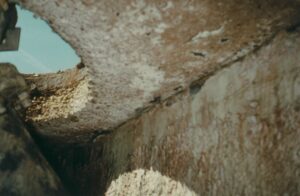
I have witnessed first hand the 25-30+ year success stories of tanks lined with Elastomeric Polyurethanes. Having been the coating inspector on projects where the tank was scheduled for re-lining, I found myself scratching my head wondering why the contractor was about to attempt to remove perfectly good elastomeric polyurethane lining with only approximately 5-10% of areas showing minor corrosion. Why would the owner want to remove a liner that was obviously performing well, only to replace it with the same system (sometimes with a lesser system), when a few touch up repairs could have extended the life cycle for another 10 + years? I found it perplexing indeed. What it really came down to in the end, was that the tank was scheduled to be re-lined and they simply proceeded with the plan. The re-lining plans are designed around the thin film epoxy technology and lifecycle expectations from days gone by, a shift in thinking and expectations regarding life cycles is required. With the constant pressure and restraints on Municipal budgets, maximizing the lifecycle or their assets has never been more important. Recent polling has shown that 75% of Owners identify “Longer Life Cycle” as their main concern when developing plans for lining and coating their tanks. I strongly suggest consideration of Elastomeric Polyurethanes as a means to reach maximum life cycle performance.
It is always challenging to gain acceptance of a new product or a new procedure within the engineering and owner community. I often hear, “I don’t want to be the Guinea Pig”. I fully understand that no one wants to take undue risk, however a switch to Polyurethane technology will definitely not make anyone the “Guinea Pig”; this technology is tried and true. While it may be a new approach to many, it is far from unproven.
A summary of the initial benefits of elastomeric polyurethane are as follows;
This summary provides the main features of elastomeric urethane, let’s now break down each feature and provide the expected benefit to both the applicator and the owner of the tank.
Elongation & Abrasion Resistance – There are two separate thermal dynamics taking place inside a water tank during hot and cold thermal expansion and contraction cycles. The steel itself is expanding and contracting as the temperatures fluctuate, and the water itself is freezing and thawing. In Northern climates like the Northern US and all of Canada, temperatures can change quite drastically, even in one day. It has been said that in certain northern cities such as Minneapolis, Chicago, Detroit or Toronto you can experience all 4 seasons in one 24 hour period. The expansion coefficient of steel is 7.2 x 10ˉ⁶, using this formula and taking a temperature change from 0°F to 75°F; we have a temperature change of 75°. Continuing you would multiply 0.0000072 x 75 to get an expansion coefficient of 0.00054. As an example take a steel rod 100 inches long you multiply 100 x 0.00054 to establish that the steel would get .054 inches longer with this temperature differential. When this type of calculation is expanded on for the size of the tank, we can see that the expansion properties provided by elastomeric polyurethane will offer substantial benefit.
Water is unique in that it reaches maximum density at 39°F (4°C) before freezing and becomes less dense when it totally freezes (which is why it floats) and buildup in the top of tanks and tank walls can be 2-3’ thick during deep a winter freeze. That is 2-3’ of ice floating, scraping and impacting the tank lining with significant force. The elastomeric properties inherent with polyurethanes of this nature provide enough give to allow the ice to move without causing any damage to the coating.
Many questions have been asked as to why the elongation is a benefit when lining a steel water tanks? The answer to this is simply, steel moves, it expands during hot summers and contracts during the colder winter months. This is one reason Elastomeric Polyurethane provides a greater benefit in colder climate regions vs more temperate climates as mentioned earlier. Where this is most notable is on the roof structure of tanks where there are more leading edges, support bracing and other nooks and crannies. The areas where I have witnessed most coating failures in tanks over the years tend to be on the roof structures. The superior elongation properties address this issue.
Typical 100% high build epoxy coatings that have been used for several years in the potable water market will have elongation properties between 2-5%, while elastomeric polyurethanes show elongation properties >40%. In many markets in the US, 2-3 coat solvent based, (low solids epoxies 60-80% VS) are still being specified for lining potable water tanks (not practiced in Canada), this is a practice that I do not understand, considering the advancements the industry has made in one coat high build lining systems. Most low solids epoxies are not tested for elongation properties, and even if they were the results would be quite low. These low volume solids systems are typically applied over 2-3 coats at 12- 16 mils and perform very poorly with the thermal dynamics and ice float.
Low Temperature Cure – 100% Solids epoxy products widely specified in the industry today cure down to temperatures in the 35°F (2°C) range, and typically take approximately 48 hours to fully cure at these temperatures. 35°F (2°C) is quite low and will accommodate many locations across North America in the early and late fall as well as later spring applications; however there is always a desire to start projects later in the year and earlier in the spring/winter to avoid taking tanks out of service during more peak usage times. Elastomeric Polyurethanes will cure down to 25°F (-4°C) which will extend the coating season slightly further and also allow the contractor to reduce the amount of heating used on a project, which in turns lowers the cost of application. The cost of heating a tank internal for lining can be as much as $5000-$10,000 per day depending on the tank size. Reducing the need for heating can save substantial budget dollars on any project.
Higher Film Build in One Coat – Epoxy resins are capable of applications of 20-50 mils
DFT in single applications meeting AWWA D102 Standards for ICS#3 (Interior Coating System). For most applications on steel this is acceptable. The only issue with this is if there is pitting in the steel. If there is pitting, a separate pit filler must be used to fill deeper pits. Most epoxy is only NSF approved to 50 mils DFT; many pits exceed 50 mils (.05”). Many Elastomeric Polyurethane linings can be applied up to 250 mils (1/4”) as per NSF, thus pits can be pre-filled using the same resin system and top coated after initial setting of the material in the pits (15-30 min). Each product will require research to verify the Dry Film Thickness/NSF approval limits.
The higher film build capabilities also provide additional benefits. Application in tight areas can be challenging and it is very easy to go over spec when using epoxies with 50 mil NSF limits. The tolerance for higher film build to stay within NSF approvals is much greater with Elastomeric Polyurethane; this eases the stress on inspectors, applicators and manufacturers to ensure they stay within NSF parameters. Elastomeric Polyurethanes also serve well on lap seams on tank ceilings due to the excellent elongation properties and often displace the need for caulking of the seams. The high build and flexible nature of Polyurethanes also perform extremely well on riveted and bolted tanks where there are multiple seams, bolts and other difficult to coat areas.
Lower Viscosity – 100% Solids Elastomeric Polyurethane have a lower initial viscosity then 100% solids epoxy and therefore require less heat at the pump to condition the material to achieve the desired spray pattern at the gun. Typical100% Solids epoxy material will require the material to be heated to 110-130°F (43-54 °C) to gain s suitable spray pattern while 100% Solids Elastomeric Polyurethane will achieve the optimal spray pattern at 80- 100 °F (27-37 °C). This is often seen as advantages to the application making it easier to pump materials longer distances. The spray equipment can often be 200-300’ away from the area that is being lined. Some versions of Elastomeric Polyurethane also have slower initial gel times which allow them to be used as a stripe coat material. This is difficult, if not impossible when using plural component spray 100% Solids Epoxy material. The set time is simply too fast with epoxy and a separate stripe coating material is necessary.
Excellent Bond to Blasted Steel (Self Priming) – Elastomeric Polyurethane can be applied to holding primers, however maximum adhesion (The same goes for Epoxy) is achieved when the product is applied directly to clean blasted steel with a suitable surface profile. Adhesion values of >1500 psi as per ASTM D4541 are expected. We promote the use of Dehumidification equipment and application direct to blasted steel whenever it is feasible. The only time it is not truly feasible is when lining large ground storage tanks where the size of the dehumidification equipment would be too large to be practical. In normal tanks of 2 million gallons or less, dehumidification and application direct to blasted steel provides the optimum adhesion values.
Quick Return to Service – Scheduling is often a major factor on projects and returning the tank to service in a timely manner is often required or at the very least desired. Elastomeric Polyurethanes offer similar return to service times as 100% solids Epoxy for immersion as per NSF. Return to service times of 24-72 hours is typical. Standard solvated epoxies require a minimum of 7 days @ 75°F to cure for immersion and can be as much as 2-3 weeks under adverse conditions.
In summary I would highly recommend that owners, specifiers and engineers take a much closer look at the advantages of Elastomeric Polyurethane materials when designing their rehabilitation or new potable water storage tank projects. Hopefully this paper has assisted in providing a better understanding of the overall benefits of doing so.